RAIFFEISEN ZEITUNG · 15 OCTOBER 2026 · CULTURE / STAGE
The fate of the Trojan princess Polyxena long remained a silent footnote to the Trojan War. A spectacular archaeological discovery and the duo FOX ON ICE bring the ancient tragedy into our present.
By Manfred Horak
Anyone thinking of the Trojan War inevitably hears the clashing of bronze. We think of Achilles’ heroic displays of muscle, Odysseus’ cunning schemes, and an enormous wooden horse. For centuries, patriarchal historiography has fed us this martial elegy to testosterone. Homer sang of the glory of men, and posterity applauded blindly. But where does the truth lie? Without the poetry of the ancient writers, we would visit these ancient sites today as nothing more than lifeless ruins. Yet beneath their embellished verses lie cruel realities.
The Trojan War eventually gave rise to the question of what was the finest and noblest of all the spoils. Gold, silver and precious stones paled beside the beauty of the young Polyxena, the captive daughter of Troy’s last royal couple, Priam and Hecuba. Her fate was sealed: she was to be sacrificed as the most valuable prize. While libraries were filled with accounts of kings and warriors, this woman’s voice remained unheard.
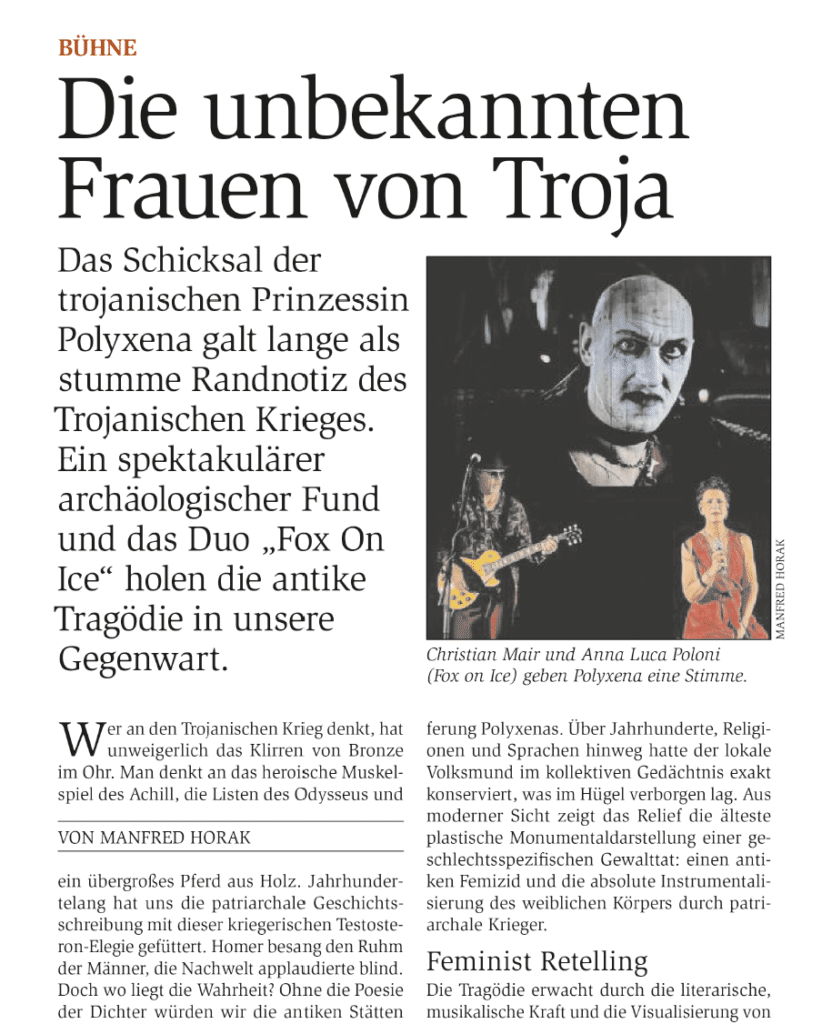
On 13 August, the duo FOX ON ICE celebrated the world premiere of POLYXENA, the second part of their FE.MALE MYTH trilogy, at the state-of-the-art Troy Museum in Çanakkale, Türkiye. The interdisciplinary Performing Arts Concert combines music, theatre, literature and film. It features Anna Luca Poloni (text and vocals), Christian Mair (music), and the magnificent Korhan Basaran, who appears on screen as Hecuba, Polyxena’s mother. This work restores a space to women whose voices had been silenced. Three thousand years ago, others spoke on their behalf; in this performance, Polyxena herself has the floor.
What may seem like a modern feminist deconstruction is rooted in a sensational archaeological discovery. In 1994, a burial mound dating from around 500 BC was discovered near Troy. For generations, local villagers had traditionally called it the Kızöldün Tumulus, meaning “the hill where the girl died.” When archaeologists unearthed the marble sarcophagus, they discovered a detailed depiction of Polyxena’s brutal sacrifice.
Across centuries, religions and languages, local oral tradition had preserved in collective memory precisely what lay hidden inside the mound. From a modern perspective, the relief represents the oldest monumental sculptural depiction of an act of gender-based violence: an ancient femicide and the absolute instrumentalisation of the female body by patriarchal warriors.
The tragedy comes alive through the literary and musical power and visual imagery of FOX ON ICE. With its radical shift in perspective, the production rides the leading edge of a global cultural phenomenon known as Feminist Retelling.
The feminist retelling of ancient myths has long since emerged from the niche of academic gender studies. Bestselling authors such as Madeline Miller (Circe) and Natalie Haynes (A Thousand Ships) are storming the international fiction charts and the viral world of BookTok.
What this literary movement achieves on the page, Anna Luca Poloni and Christian Mair bring to the stage live in 16 powerful and moving songs. They fill the gaps left by historical narratives and give a voice to women who were denied one for centuries.
The response in Troy proved that the concept works. The courage to break with stylistic conventions became an artistic triumph. The local audience, a mixture of tradition-conscious visitors to the Troy Festival taking place at the same time and a younger generation, was deeply moved by the sharpness of the texts:
“Hey, men, I need some explanations – would you listen to me? Can’t you see your will for power caused the whole shit?”
Some women began to cry, for instance when the following words were spoken:
“How much I wanted a normal life! Mother always used to say I was the only one of her kids who had a certain talent for it. But in the end I learned – what? Protest? Rebellion? Courage? Probably I learned to be mother’s child – the hard way …”
FOX ON ICE demonstrates that myths are not set in stone. They merely need to be charged with enough creative electricity to illuminate the present.
In Austria, POLYXENA will be presented for the first time at the Wortwiege theatre festival (16 February to 21 March 2027) in Wiener Neustadt.
Image caption: Christian Mair and Anna Luca Poloni (FOX ON ICE) give Polyxena a voice.
This article was automatically translated into English.